Featured Story
Featured Story
Maternal Health is an orphan prevention strategy
About HCW
Reports on accountability, stewardship, and allied funding processes.
Our Work
Our Ideas
Data, research, publications, media, curriculum, worship materials, and essential resources.
Empowerment approaches to development, locally led collaborations, respectful alliances, ethical practices, and sustainable progress.
The CRC Programs have changed significantly.
| Orphanage to Family Care | Family Care to An Institutional Model |
|---|---|
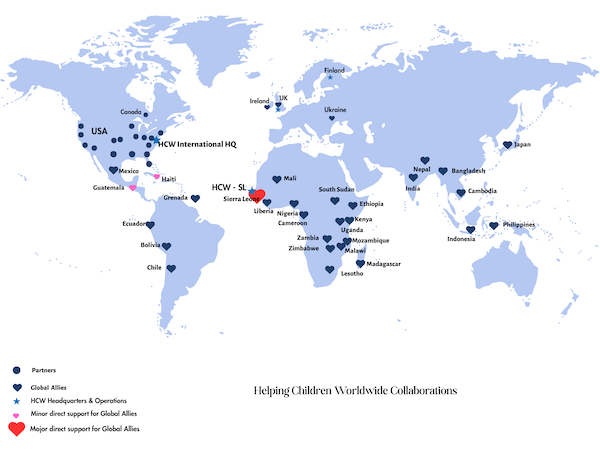
| Not long after the orphanage was established, the Child Rescue Centre (CRC) outgrew the building where it began, serving now over 75 children in residence. The residential program was never all that John Yambasu or his friends at Helping Children Worldwide had envisioned. Thinking of ways to reach more children in need, the CRC and HCW leadership agreed that access to education was crucial to ending generational poverty. Since no schooling was provided without cost in Sierra Leone at the time, the poorest families had to often choose between educating or feeding their children the one meal per day they were used to eating. Seeing all the school age children who were not in school, and noting the extremely high illiteracy rates and unemployment rates were continuing to increase after the impact of war, the allies agreed to work together to provide tuition and school supplies to impoverished children. They set about offering enrollment in a CRC school support program for local children whose parents were unable to adequately feed or house their children and also send them to school. By 2005, there were as many or more children living outside the residence who were enrolled in the CRC’s child and family support programs, receiving financial assistance, food, healthcare tuition, school fees, uniforms, shoes and school supplies. From those first 40 children, over the next 16 years, the CRC grew to include a spectrum of programs serving more than 600 extremely vulnerable children and youth, helping them escape the vicious cycle of poverty and develop their full potential. Many of the children who had been in residence at CRC had attended college with aid of scholarships from Helping Children Worldwide (HCW) and returned as professionals to run the institutions that had been originally formed to help them. Beginning in 2016, these care-leavers used their experience and education to transform the work and improve it, advocating for family care over residential placement. On the HCW side, professional staff had been hired, including highly educated program staff who brought best practice standards to their discussions with CRC and HCW governing boards. With convincing advocacy for transformation on both sides, by 2018, CRC had become a leading edge institution in the care reform movement. All of the children in residence were living in families, most of them reunited with their own parents, siblings and family. Because of the deep commitment to the welfare of the children in residence, the allies worked together to develop a mindful reintegration process that would prove to result in sustainable reintegrations for the entire family, in addition to addressing child protection issues and the immediate child welfare needs of the children who would be reintegrated. Once the children were all living in families, some might think the work of the CRC was complete. Some actually suggested as much. But the work did not end there, as the goal was to end the cycle of child poverty, permanently, and to do so by ensuring every child they enrolled in their programs lived with a sense of belonging in safe, loving, and strong families. | With the CRC family support program in the community as their original service model, the allies began to adjust their mode of collaborating, as well as increasingly focused on the best practices that would increase staff professionalism and capacity to provide the services needed to support the empowerment of strong families. Their work from that point forward focused on building on the unique family strengthening services they had collaborated to develop. In 2020, the Child Reintegration Centre was born from the new vision of the CRC leadership.Growing from the leadership of senior staff, not only did CRC transform its work to focus on sustaining families, healing and preventing family separation, it began teaching others about their successes.Helping Children Worldwide enjoys an international reputation as a thought leader and best practice organization in part because of the various networks to whom we belong, but primarily due to our experience in global alliance with the CRC. Since joining the Christian Alliance for Orphans in 2019, HCW has enjoyed the fruits of collaboration with other world leaders in child welfare and child protection through connections made at CAFO’s annual Summit, including work with 1MILLIONHOME, Better Care Network, and Faith to Action.As a result of that increased profile, the HCW/CRC alliance was invited to apply for a grant to add a department to formally expand on its work in care reform education and advocacy, and became an international teaching site for care reform. Shortly thereafter, increased demands were made for their expertise in transition services, and HCW facilitated their work in Nigeria, Liberia, Kenya, and Mozambique.Dr. Laura Horvath of HCW had been called to serve during the annual Transition to Family Care Simulation Experience, and multiple presentations from transition to case management, and even a workshop entitled Shifting Your Dedicated Donor Program from Child Sponsorship to Family Advocacy with Emmanuel Nabieu. In addition, HCW and CRC were selected to participate in a research grant to evaluate the effectiveness of the Firmly Rooted Parenting curriculum for villages enrolled in the VP program. HCW has shared Nabs’ book, My Long Journey Back Home, which draws heavily from his time as a resident, and then director at the CRC, and presented the Breaking Bread series materials, and the newly revised Firmly Rooted Parenting curriculum at multiple conferences, as well as the trailer for our upcoming documentary: Firmly Rooted! In recent years, the changes we have made to balance our relationship with CRC has resulted in their rise to the global stage, with David Musa and George Kulanda both making multiple formal presentations at the CAFO conference, and David Musa presenting in forums all across the globe (mostly through remote participation or in the US). |