Featured Story
Featured Story
Maternal Health is an orphan prevention strategy
About HCW
Reports on accountability, stewardship, and allied funding processes.
Our Work
Our Ideas
Data, research, publications, media, curriculum, worship materials, and essential resources.
Empowerment approaches to development, locally led collaborations, respectful alliances, ethical practices, and sustainable progress.
Our impact is greater when we occupy our right lane in global alliance. Funding priorities shift from program-centric management to objective-oriented leadership. We invest in activities that build capacity through collaboration and allyship.
Sustainability: While it is certainly less complicated to be fully in charge of program decisions and outcomes, we have learned that doesn’t result in long term success. Regardless of the subject matter, reliable success comes from the ground up. Relief models are meant to be short-term “relief” of a crisis.
Continuously operating from a relief perspective is unsustainable, and “remote control” operation models are ineffective in generating long term change. You can effectively respond to immediate crisis and stabilize a dangerous situation with relief – and we do provide crisis relief from time to time as required, but attempts to externally generate lasting change are ultimately ineffective and prone to failure.
We have found it is better to live with incremental gains as communities take full ownership, and to recover from the losses of that process, than to repeatedly come face-to-face with the realization that years of expensive investments and efforts produced no long-term permanent societal change. In a relief model, one child in crisis might be helped for as long as the supports are available, but it does not translate into success for the child if supports are removed, or help for the next child in crisis.
Cost-effective: Attempting to live into our name in the past with a program management perspective, resulted in labor-intensive and complex structures of oversight to design, initiate, fund, employ, operate, monitor, and evaluate.
With a workforce as small as ours, even with hundreds of loyal and consistent volunteers, attempts to manage programs where we are cannot provide hands-on direction due to distance, cultural, and language conflicts results in frustration of mission purpose and frequent instances of corruption by those who are not motivated by a sense of ownership and responsibility.
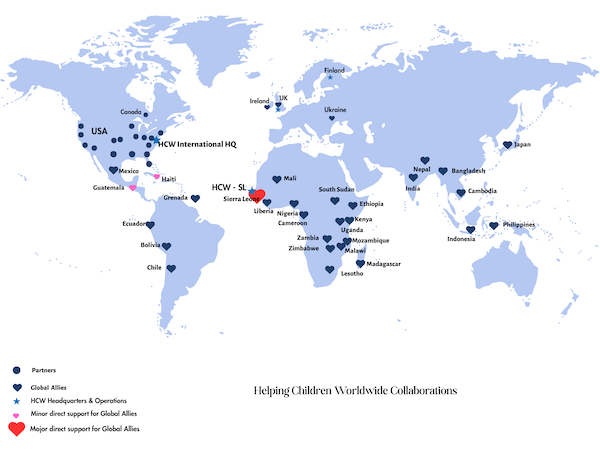
We get that question most frequently from long-time supporters of the Child Reintegration Centre and Mercy UMC Hospital. The vast majority of our direct support of global allies is being spent in Sierra Leone, West Africa. No funding that is intended to be used for those programs would be directed elsewhere. We are legally obligated, and ethically committed to using donor dollars for the purposes for which they were given. Donor integrity rules are very clear in the United States, where our organization is authorized as a 501(c)(3) tax exempt organization.
Our work in Haiti and Guatemala is in early stages of development and no dedicated donors have been developed as yet, outside of those who support the work by donating to the Together for Global Health network, as those organizations are both midwifery programs. The family services program we ran in Northern Virginia was transferred to Reston Interfaith in 2012, and the donors who were developed to support that initiative transferred their support to Reston Interfaith, and hopefully continue their support for the successor to our Connections for Hope program. Consequently, the majority of our championship work is engaging with local programs in Sierra Leone, particularly those who have dedicated support, like CRC, CFPS, Mercy UMC Hospital, Healey Relief Foundation, and the Midwifery Training program.
We have many committed donors who currently support the work in Sierra Leone and have been doing so for decades. Dedicated donations must be used for the purposes donated. Consequently, we have significantly more funds to share with our allies in Sierra Leone than we do with our allies in Haiti and Guatemala. We continue to work with our mission support partners, to seek out and grow new partnerships, and develop additional funding streams and resources we can link to needs to support all allies with whom we work.
We get also seem to get that question most frequently from long-time supporters of the Child Reintegration Centre and Mercy UMC Hospital. That is unsurprising, as are work grew out of the relationship between two UMC pastors considering the devastation of war and its impact on children in Africa – and the Christian outreach of a single UMC congregation in Herndon, Virginia. That congregation’s intention to set us up to operate purely from the example and teaching of Jesus means we are free to be unrepentantly joyous in sharing our love indescriminately with all people in the world.
We work with vastly different groups of people, and using precise language keeps us better aligned in managing our relationships with one another. The term “global partner” or “HCW partner” is reserved for relationships that are formed to come together with HCW to support others, such as the HCW Church Partners. The term “global alliance” is used to distinguish the relationships where we are focused on capacity-building to support a local program or organization’s ability to meet its program goals and outcomes, and we have entered into an MOU that establishes each party’s obligations and role in the relationship.
We use “global collaboration” or “global network” to describe relationships that are established by shared goals of a group. Sometimes those are described in a project plan or a joint grant application, and sometimes in a group generated document such as bylaws, group statement of purpose, or published mission objectives. When HCW enters into a collaborative project, such as The Maternal and Infant Health Training Initiative in Sierra Leone, which came out of the Global Network of Together for Global Health, we work in alliance and partnership with multiple local agencies, educational and medical institutions, as well as their counterparts who come together from across the globe to participate in the project. The network has a statement of purpose, and the training has a formal project plan.
Operating in collaborations and networks means sharing goes two-ways, and sometimes HCW is on the giving end supporting an ally, and sometimes HCW is on the receiving end being supported by a partner, and sometimes, as is often the case with Healey International Relief Foundation, we are both.