Featured Story
Featured Story
Maternal Health is an orphan prevention strategy
About HCW
Reports on accountability, stewardship, and allied funding processes.
Our Work
Our Ideas
Data, research, publications, media, curriculum, worship materials, and essential resources.
Empowerment approaches to development, locally led collaborations, respectful alliances, ethical practices, and sustainable progress.
strongfamily4everychild.org
HCW is the secretariat and convener of the Strong Family for Every Child Coalition.
In 2021, Helping Children Worldwide convened a group of like-minded mission leaders from the United Methodist Church community to discuss a strategy to introduce the importance of family care, and ending the trauma caused by institutionalization of children because of poverty.
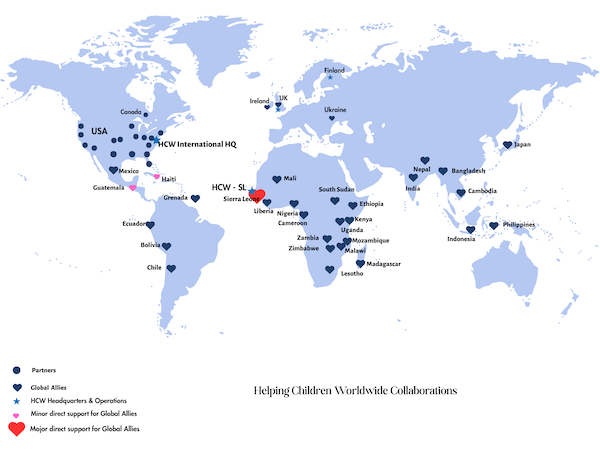
HCW learned a lot of hard lessons going through a transition with our global allies in Sierra Leone to get us both out of the orphanage industry. Tough, honest, and thorough examination of the reality of the orphanage model and the harm it causes leaves good people with no choice but change. Emmanual “Nabs” Nabieu, a careleaver from the Child Reintegration Centre, who spent 10 years of his life there, returned after University to work there and eventually rose to the position of Director. In the US, Dr. Laura Horvath was collaborating on the rising instances of child-on-child abuse at the CRC with Nabs, trying to figure out what was happening. What she learned supported Nabs’ deep belief that there had to be a better way to address child poverty than separating families, and his experience of the consequences of being separated. They began to advocate for change on both sides of the ocean. But that doesn’t mean undertaking change when you know change is needed isn’t a hard thing to do, or that people who haven’ve reached that realization are bad humans, or terrible followers of Christ.
The decision to close UMC SLAC’s Child Rescue Centre, our longest program ally, was difficult on both sides of the ocean. It meant the alliance had to commit to that course of action without any certainty of what would come next. It meant the staff might become unemployed in an environment with little to no social safety nets. It meant the compound and facility where so much money had been invested might decay in a state of abandonment. It meant the children were going to leave the place of safety that had been constructed, the schools, friends, church community, and the people who had been their caregivers for many years. The careful, well-planned transformation took years, from 2016 until the last child returned home in 2019. CRC took time to do investigations and family tracing, to make reintegration a gentle, successful process. Reintegrating the last 20 children was frightening for the staff and the stakeholders. But the work that followed transformed the CRC and its existing child protection and family strengthening programs into the now famous Child Reintegration Centre. And the story of navigating that decision, and the journey before and after it, was HCW’s honest entry onto the global stage.
It seemed that the work had been slow and our leadership and staff were a little embarrassed that the UN Rights of the Child had been adopted ten years earlier. But what we learned in explaining the experience to the global child welfare community was that it was one of the few successful voluntary transformations, rare and special, and kind of amazing. The foot-dragging is common, the reluctance to change familiar, and the courage to move foreward – wasn’t. They didn’t think we had been dragging our feet; they wanted to know how we had accomplished it. They wanted us to teach them how they could convince others to do it too – and give them a roadmap to success, not just in the decision-making, but in the actual transformation of a program from orphanage to family-care support.
That is why, prior to 2021, HCW developed a conversation guide call Table Fellowship to use in initiating and having difficult conversations about orphan care, orphanages, care reform and change. We developed 3 different guides, and those guides were step one. We offered them to the people who wanted to start as we had started, with a difficult conversation. Step two was beginning a conversation with other UMC leadership. Step three was bringing the Table Fellowship program to the Leadership Summit of the United Methodist Church held at Church of the Resurrection, to initiate a conversation.
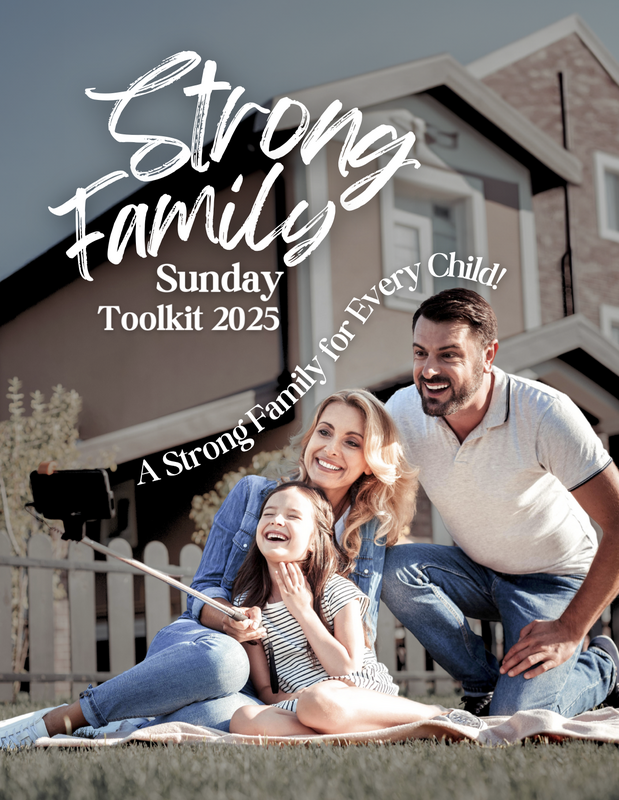
From that experience came the next act of the coalition, an annual celebration of the family that draws the line between child resilience and family strength, and highlights every ministry program the faith community supports to make families stronger and their children more resilient.
HCW created a bible study for James 1:27 to be used to celebrate the Abrahamic traditions’ mutual regard for caring for the widow and the orphan as a family unit, and not the widow OR the orphan. it has been utilized by a number of churches for small group study.
Annually, HCW prepares a worship guide for Strong Family Sunday – on the same day as Orphan Sunday, World Orphan Day, and Stand Sunday – celebrating foster families.
The coalition has its own website StrongFamily4EveryChild.org
You can download the Strong Family Toolkit from our resources list on the North American page, and find links to the discussion guides, workbooks and bible studies.