

Abstract
Purpose
In Sierra Leone, violent discipline has been rarely studied, although it has been shown to predict poor outcomes elsewhere. Our purpose was to examine which discipline practices a sample of vulnerable Sierra Leonean caregivers are willing to use and their associations with caregiver–child relationship quality.
Method
Surveys were conducted with N = 113 pairs of caregivers and their 9-to-13-year-old children around Bo, Sierra Leone, who were enrolled in a program for families at risk of separation. Descriptive statistics and item response theory analysis examined caregivers’ willingness to use discipline practices and their normativity among caregivers. Pearson’s correlations examined discipline and relationship quality; multiple linear regression did the same while controlling for demographics.
Results
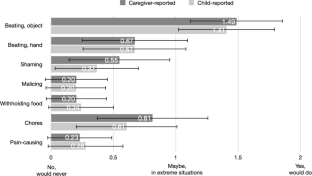
Caregivers were most willing to hit a child with an object or hand and least willing to ignore the child, withhold food, or use pain-causing punishments like “knee-walking.” The violent discipline scale predicted worse attachment and caregiver-reported violent discipline predicted worse rejection. The IRT analysis revealed that the discipline practices that reflected a higher latent severity of the discipline construct (e.g., ignoring) were those that were more strongly associated with poor relationship quality, whereas highly normative practices (e.g., beating with an object) exhibited weaker associations.
Conclusions
Our study uncovered the prevalence of several discipline methods used in Sierra Leone but rarely included in Western-derived measures. Parenting interventions aimed at improving child and family outcomes should particularly discourage ignoring, shaming, and pain-causing punishments. Policymakers should also consider addressing psychological aggression and emotional abuse in child rights legislation rather than corporal punishment alone.

Data Availability
Data and other materials used in this study are available from the corresponding author upon reasonable request.
References
Armsden, G. C., & Greenberg, M. T. (1987). The Inventory of Parent and Peer Attachment: Individual differences and their relationship to psychological well-being in adolescence. Journal of Youth and Adolescence, 16(5), 427–454. https://doi.org/10.1007/BF02202939
Ashburn, K., Kerner, B., Ojamuge, D., & Lundgren, R. (2017). Evaluation of the Responsible, Engaged, and Loving (REAL) Fathers Initiative on physical child punishment and intimate partner violence in Northern Uganda. Prevention Science, 18(7), 854–864. https://doi.org/10.1007/s11121-016-0713-9
Barr, A., Garrett, L., Marten, R., & Kadandale, S. (2019). Health sector fragmentation: Three examples from Sierra Leone. Globalization and Health, 15(1), Article 8. https://doi.org/10.1186/s12992-018-0447-5
Beatriz, E., & Salhi, C. (2019). Child discipline in low- and middle-income countries: Socioeconomic disparities at the household- and country-level. Child Abuse & Neglect, 94, Article 104023. https://doi.org/10.1016/j.chiabu.2019.104023
Behr, D., & Braun, M. (2023). How does back translation fare against team translation? An experimental case study in the language combination English-German. Journal of Survey Statistics and Methodology, 11(2), 285–315. https://doi.org/10.1093/jssam/smac005
Betancourt, T. S., Borisova, I. I., Williams, T. P., Brennan, R. T., Whitfield, T. H., De La Soudiere, M., Williamson, J., & Gilman, S. E. (2010). Sierra Leone’s former child soldiers: A follow-up study of psychosocial adjustment and community reintegration. Child Development, 81(4), 1077–1095. https://doi.org/10.1111/j.1467-8624.2010.01455.x
Betancourt, T. S., Thomson, D. L., Brennan, R. T., Antonaccio, C. M., Gilman, S. E., & VanderWeele, T. J. (2020). Stigma and acceptance of Sierra Leone’s child soldiers: A prospective longitudinal study of adult mental health and social functioning. Journal of the American Academy of Child and Adolescent PsychiatRy, 59(6), 715–726. https://doi.org/10.1016/j.jaac.2019.05.026
Bowlby, J. (1969). Attachment and loss (Vol. 1). Basic Books.
Bronfenbrenner, U. (1979). The ecology of human development: Experiments by nature and design. Harvard University Press.
Chandra, A., Mani, S., Dolphin, H., Dyson, M., & Marah, Y. (2021). Experimental evidence from an integrated early childhood parenting program in Sierra Leone. IZA Discussion Papers. https://doi.org/10.2139/ssrn.3771737
Chandra, A., Mani, S., Dolphin, H., Dyson, M., & Marah, Y. (2022). Improving parenting practices and child health: Experimental evidence from Sierra Leone. Fordham University Department of Economics Discussion Paper Series, 2023–08. https://archive.fordham.edu/ECONOMICS_RESEARCH/PAPERS/dp2023_08_chandramanietal.pdf
Cluver, L. D., Meinck, F., Steinert, J. I., Shenderovich, Y., Doubt, J., Herrero Romero, R., Lombard, C. J., Redfern, A., Ward, C. L., Tsoanyane, S., Nzima, D., Sibanda, N., Wittesaele, C., De Stone, S., Boyes, M. E., Catanho, R., Lachman, J. M., Salah, N., Nocuza, M., & Gardner, F. (2018). Parenting for lifelong health: A pragmatic cluster randomised controlled trial of a non-commercialised parenting programme for adolescents and their families in South Africa. BMJ Global Health, 3(1), Article e000539. https://doi.org/10.1136/bmjgh-2017-000539
Devlin, A. M., Wight, D., & Fenton, C. (2018). Are parenting practices associated with the same child outcomes in sub-Saharan African countries as in high-income countries? A review and synthesis. BMJ Global Health, 3(6), Article e000912. https://doi.org/10.1136/bmjgh-2018-000912
End Corporal Punishment. (2023). Corporal punishment of children in Sierra Leone. https://endcorporalpunishment.org/reports-on-every-state-and-territory/sierra-leone/
Gershoff, E. T., Grogan-Kaylor, A., Lansford, J. E., Chang, L., Zelli, A., Deater-Deckard, K., & Dodge, K. A. (2010). Parent discipline practices in an international sample: Associations with child behaviors and moderation by perceived normativeness. Child Development, 81(2), 487–502. https://doi.org/10.1111/j.1467-8624.2009.01409.x
Knerr, W., Gardner, F., & Cluver, L. (2013). Improving positive parenting skills and reducing harsh and abusive parenting in low- and middle-income countries: A systematic review. Prevention Science, 14(4), 352–363. https://doi.org/10.1007/s11121-012-0314-1
Lansford, J. E., Chang, L., Dodge, K. A., Malone, P. S., Oburu, P., Palmérus, K., Bacchini, D., Pastorelli, C., Bombi, A. S., Zelli, A., Tapanya, S., Chaudhary, N., Deater-Deckard, K., Manke, B., & Quinn, N. (2005). Physical discipline and children’s adjustment: Cultural normativeness as a moderator. Child Development, 76(6), 1234–1246. https://doi.org/10.1111/j.1467-8624.2005.00847.x
Lee, M., & Boyle, E. H. (2021). Disciplinary practices among orphaned children in sub-Saharan Africa. PLoS ONE, 16(2), Article e0246578. https://doi.org/10.1371/journal.pone.0246578
Neville, S. E., Kim, E. J., Horvath, L., Vaughan, Y., Kulanda, G., Baun, J., Naavo, M., & The CRC Case Management Team. (2025). Family strengthening to prevent family separation and entrance into residential care institutions in Sierra Leone: A quasi-experimental study. Child & Youth Care Forum. https://doi.org/10.1007/s10566-025-09866-4
Pinquart, M. (2021). Cultural differences in the association of harsh parenting with internalizing and externalizing symptoms: A meta-analysis. Journal of Child and Family Studies, 30(12), 2938–2951. https://doi.org/10.1007/s10826-021-02113-z
Puffer, E. S., Green, E. P., Chase, R. M., Sim, A. L., Zayzay, J., Friis, E., Garcia-Rolland, E., & Boone, L. (2015). Parents make the difference: A randomized-controlled trial of a parenting intervention in Liberia. Global Mental Health, 2, Article e15. https://doi.org/10.1017/gmh.2015.12
Pundir, P., Saran, A., White, H., Subrahmanian, R., & Adona, J. (2020). Interventions for reducing violence against children in low- and middle-income countries: An evidence and gap map. Campbell Systematic Reviews, 16(4), Article e1120. https://doi.org/10.1002/cl2.1120
Rohner, R. P. (1986). The warmth dimension: Foundations of parental acceptance-rejection theory. Sage Publications.
Rohner, R. P. (2005). Parental Acceptance-Rejection Ques-tionnaire (PARQ): Test manual. In R. P. Rohner & A. Khaleque (Eds.), Handbook for the study of parental acceptance and rejection (4th ed., pp. 43–106). Rohner Research Publications.
Rohner, R. P., Kean, K. J., & Cournoyer, D. E. (1991). Effects of corporal punishment, perceived caretaker warmth, and cultural beliefs on the psychological adjustment of children in St. Kitts, West Indies. Journal of Marriage and the Family, 53(3), 681–693. https://doi.org/10.2307/352743
Statistics Sierra Leone. (2018). Sierra Leone Multiple Indicator Cluster Survey 2017 survey findings report. https://mics.unicef.org/sites/mics/files/Sierra%20Leone%202017%20MICS%20Statistical%20Snapshots_English.pdf
Swinford, S. P., DeMaris, A., Cernkovich, S. A., & Giordano, P. C. (2000). Harsh physical discipline in childhood and violence in later romantic involvements: The mediating role of problem behaviors. Journal of Marriage and Family, 62(2), 508–519. https://doi.org/10.1111/j.1741-3737.2000.00508.x
Taber, S. M. (2010). The veridicality of children’s reports of parenting: A review of factors contributing to parent–child discrepancies. Clinical Psychology Review, 30(8), 999–1010. https://doi.org/10.1016/j.cpr.2010.06.014
The DHS Program. (n.d.). Wealth Index. https://dhsprogram.com/topics/wealth-index/
UNDP Sierra Leone. (2023). Multidimensional poverty in Sierra Leone. https://www.undp.org/sierra-leone/publications/multidimensional-poverty-index-sierra-leone
UNICEF. (2023). Violent discipline. UNICEF Data. https://data.unicef.org/topic/child-protection/violence/violent-discipline/
United Nations General Assembly. (1989). Convention on the rights of the child. https://www.ohchr.org/EN/ProfessionalInterest/Pages/CRC.aspx
Visser, L., Van Der Put, C., & Assink, M. (2022). The association between school corporal punishment and child developmental outcomes: A meta-analytic review. Children, 9(3), Article 383. https://doi.org/10.3390/children9030383
Ward, C. L., Wessels, I. M., Lachman, J. M., Hutchings, J., Cluver, L. D., Kassanjee, R., Nhapi, R., Little, F., & Gardner, F. (2020). Parenting for lifelong health for young children: A randomized controlled trial of a parenting program in South Africa to prevent harsh parenting and child conduct problems. Journal of Child Psychology and Psychiatry, 61(4), 503–512. https://doi.org/10.1111/jcpp.13129
Wiggers, M., & Paas, F. (2022). Harsh physical discipline and externalizing behaviors in children: A systematic review. International Journal of Environmental Research and Public Health, 19(21), Article 14385. https://doi.org/10.3390/ijerph192114385
World Health Organization. (2016). INSPIRE: Seven strategies for ending violence against children. World Health Organization. https://iris.who.int/handle/10665/207717
World Health Organization. (2023). WHO guidelines on parenting interventions to prevent maltreatment and enhance parent–child relationships with children aged 0–17 years. https://www.who.int/teams/social-determinants-of-health/violence-prevention/parenting-guidelines
Zuilkowski, S. S., Thulin, E. J., McLean, K., Rogers, T. M., Akinsulure-Smith, A. M., & Betancourt, T. S. (2019). Parenting and discipline in post-conflict Sierra Leone. Child Abuse & Neglect, 97, Article 104138. https://doi.org/10.1016/j.chiabu.2019.104138
Funding
This work was supported by the Christian Alliance for Orphans Research Challenge Grant; SEN’s time was also supported by NIMH T32 MH078788. The sponsors had no role in study design; in the collection, analysis and interpretation of data; in the writing of the report; or in the decision to submit the article for publication.
Author information
Authors and Affiliations
Contributions
Sarah E. Neville: Conceptualization, data curation, formal analysis, funding acquisition, methodology, visualization, writing—original draft. Cara M. Antonaccio: Formal analysis, writing—original draft, methodology, visualization. Laura Horvath: Funding acquisition, writing—review and editing. Yasmine Vaughan: Funding acquisition, writing—review and editing.
Corresponding author
Ethics declarations
Competing Interests
SEN and CMA have no relevant financial or non-financial interests to disclose. LH and YV are employed by Helping Children Worldwide.
Additional information
Publisher's Note
Springer Nature remains neutral with regard to jurisdictional claims in published maps and institutional affiliations.
Rights and permissions
Springer Nature or its licensor (e.g. a society or other partner) holds exclusive rights to this article under a publishing agreement with the author(s) or other rightsholder(s); author self-archiving of the accepted manuscript version of this article is solely governed by the terms of such publishing agreement and applicable law.
About this article

Cite this article
Neville, S.E., Antonaccio, C.M., Horvath, L. et al. Normativity of Culturally-Specific Discipline Practices and Linkages to Caregiver–Child Relationship Quality in Sierra Leone. J Fam Viol (2026). https://doi.org/10.1007/s10896-026-01108-y
Received:
Accepted:
Published:
Version of record:
DOI: https://doi.org/10.1007/s10896-026-01108-y